7 Hidden Revenue Leaks in Dental Clinics and How to Fix Them
Identify the seven operational blind spots costing your practice thousands in revenue, from unbilled lab cases to forgotten consultation fees.

Worked examples: Any amounts, rates and scenarios below are illustrative assumptions, not measured Dentiva customer results or industry benchmarks. Replace them with your own data; billed value, collected revenue and profit are different measures.
A dental clinic is a complex retail healthcare business. Between managing chairside procedures, coordinating custom work with dental labs, scheduling patient appointments, and processing invoice reconciliations, there are dozens of operational touchpoints where revenue can slip through the cracks.
The size of a clinic's operational leakage must be measured from its own records. This checklist does not establish a national loss percentage.
Scaling a clinic with active leaks is like pouring more water into a leaky bucket - you spend more on marketing and see more patients, but your profit margins stay flat. To improve long-term dental clinic profitability, you must audit your clinic's workflows and seal these gaps permanently. This guide outlines the seven most common hidden revenue leaks in dental practices and provides an operational blueprint to fix them.
The 7 Revenue Leakage Points in Dental Practice Operations
Let's dissect the primary areas where clinical revenue disappears and assess their direct financial impact:
1. Unbilled Chairside Consumables
During complex procedures like dental implants, bone grafting, root canals, or minor oral surgeries, doctors use specialized consumables. These include bio-oss bone grafts, barrier membranes, specialized NiTi rotary files, sutures, and surgical burs.
If the treating dentist does not note these down on the treatment sheet immediately, the front desk generates a standard invoice billing only for the baseline extraction or implant procedure. The clinic absorbs the ₹3,000 cost of the bone graft vial and membrane, leaking thousands in material costs.
2. Undercharged Specialist Consultations
Many clinics rely on visiting specialists (such as endodontists, orthodontists, or oral surgeons) and pay them a fixed percentage (e.g., 40% to 50%) of the procedure fee.
If your front desk fails to collect the initial consultation fee or bills the specialist procedure using an outdated price list, the clinic's net margin is severely eroded after paying the consultant. In worst-case scenarios, the clinic actually loses money on the specialist visit after accounting for materials and chair time.
3. Lab Order Cost Mismatches
Dental clinics pay labs monthly for custom prosthetics (crowns, bridges, splints, aligners). A major leak occurs when your billing staff does not reconcile every lab bill against a paid patient invoice.
If a patient reschedules or drops out of treatment after a crown preparation, the lab still bills the clinic for the crown fabrication. Without strict audits, the clinic pays the lab bill, but the patient invoice remains unpaid or ungenerated.
4. Overlooked Follow-Up on Warm Leads
Prospective patients who call to ask about high-value treatments (like dental implants or clear aligners) are often noted in paper diaries or scratchpads.
If your reception team does not follow up with these leads within 24 hours, the lead goes cold. This represents a direct loss of initial marketing spend and potential high-ticket revenue.
5. Ineffective Recall Compliance
Letting past scaling, pediatric review, or periodontal checkup patients drift without a structured follow-up represents a massive leak of Patient Lifecycle Value.
If a patient doesn't return for routine hygiene checks, they are likely to visit a competitor when they eventually experience dental pain.
6. Forgotten Outstanding Dues
Paper ledgers and unstructured Excel sheets make it difficult to track who owes what. During busy checkout hours, receptionists under pressure often let patients leave saying "I will transfer the balance online tonight," and forget to check if the payment ever arrived. Over a year, dozens of these small unpaid balances stack up into lakhs of written-off debt.
7. Administrative Staff Dependency
Relying on a single receptionist's memory to track patient check-ins, lab statuses, and custom payment agreements is dangerous. If they go on leave or resign, your operational memory vanishes. This leads to severe billing errors, double-booked appointments, and uncollected outstanding accounts.
The Profit Impact of Revenue Leakages
Consider a dental clinic generating a gross billing of ₹5,00,000 per month. Here is how silent leakages impact the bottom line over a year:
| Leakage Source | Typical Monthly Loss | Annual Loss | Profit Reclamation Tactic |
|---|---|---|---|
| Unbilled Consumables | ₹15,000 | ₹1,80,000 | EMR material logs auto-linked to invoicing |
| Unreconciled Lab Bills | ₹12,000 | ₹1,44,000 | Matching lab invoices to patient files |
| Visiting Consultant Dues | ₹10,000 | ₹1,20,000 | Standardized digital fee catalog & tracking |
| Forgotten Dues (No follow-up) | ₹18,000 | ₹2,16,000 | Ledger aging alerts & WhatsApp payment links |
| Lost Inquiries (No CRM) | ₹25,000 | ₹3,00,000 | Centralized digital lead pipeline tracking |
| Total Clinic Leakage | ₹80,000 / mo | ₹9,60,000 / yr | Unifying operations on a central platform |
By sealing these leaks, the clinic owner can recover nearly ₹9.6 Lakhs in annual profit without increasing marketing budgets or raising treatment fees.
Actionable Framework: The Weekly Clinic Reconciliations Audit
To plug these seven leaks, clinics must establish a strict Weekly Reconciliations Protocol:
Step 1: Appointment-to-Invoice Match
Regularly compare completed appointments with the appropriate billing record. A mismatch can reflect unbilled work, a bundled visit, a non-billable review or a recording error; investigate before treating it as lost revenue.
Step 2: Lab Bill Reconciliation
Before paying your monthly lab statement, verify every line item against your patient database. Make sure that every crown or bridge listed has been successfully fitted, billed, and paid for by the corresponding patient. If a crown was fabricated but not fitted, trace the patient and reschedule the appointment.
Step 3: Dues Ledger Aging Review
Review your outstanding receivables. Identify any balances that have crossed the 30-day mark. Trigger automated, polite WhatsApp billing reminders containing digital payment links to clear the outstanding balances.
Step 4: Chairside Consumable Stock Check
Conduct a weekly count of high-value inventory items (dental implants, bone grafts, membranes, orthodontic brackets) and match the count against completed patient charts. If 5 implants were used clinically but only 4 were billed, you have identified a leakage point.
Pro Tip
Implement a "Zero-Cash Ledger Close" policy. At the end of every day, the front desk must match physical cash collections and digital transaction logs (UPI, card swipes) against the generated system invoices before closing the clinic door. This prevents daily cash discrepancies and minor pilferage.
Common Mistakes Dentists Make
Make sure your clinic avoids these auditing errors:
1. Trusting Verbal Staff Updates
Relying on staff reports like "All accounts are cleared, doctor" without reviewing digital ledgers leads to undetected leakage. Always audit data-driven reports rather than relying on verbal assurances.
2. Charging Arbitrary consultation Fees
Allowing different doctors to charge arbitrary fees for the same treatment leads to billing chaos and confuses patients. Establish a unified, digital service catalog with fixed price boundaries.
3. Not Tracking Material Consumption
Failing to audit inventory allows high-value clinical materials to be wasted, expired, or misplaced without financial accountability. Connect inventory tracking directly to your digital EMR charting.
Recovering Lost Revenue
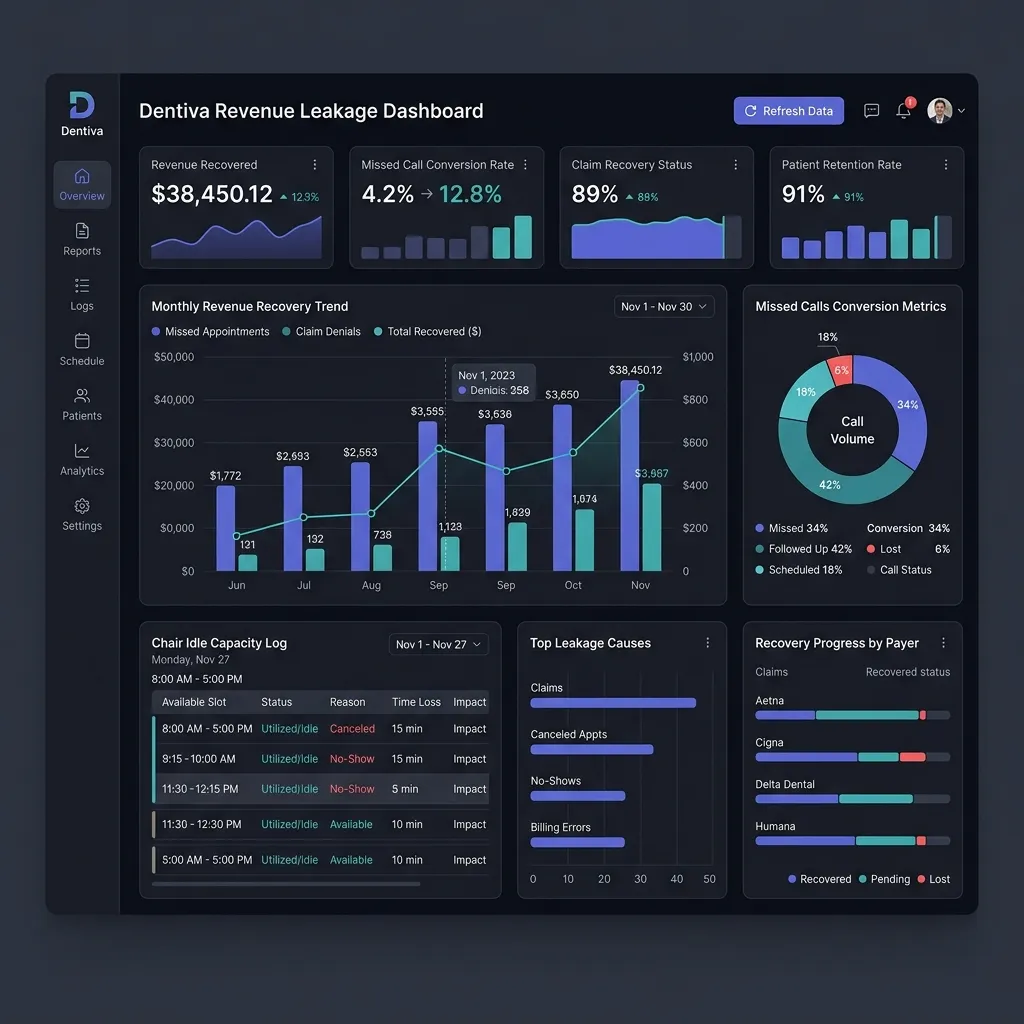 Screenshot: Dentiva Revenue Leakage Dashboard
As clinics grow, managing these financial checks manually becomes impossible. Modern clinic management platforms simplify this operational burden.
Dentiva supports clinic records, invoices, payments and configured follow-up. Check the actual plan and permissions. Staff still need to reconcile collections and lab/stock evidence; automatic treatment-to-stock reconciliation is not claimed.
Quick Action Checklist
Audit your clinic's profitability with this checklist:
Frequently Asked Questions (FAQ)
What is the average percentage of revenue leaked in Indian dental clinics?
Compare completed work, invoices and actual collections over a defined period. No verified national loss percentage is provided here.
How does EMR-linked inventory prevent material leakage?
Compare supported stock records with treatment and billing evidence. A stock discrepancy needs investigation; do not assume every clinical entry automatically creates an invoice line or stock deduction.
How do we prevent front-desk staff from offering unauthorized discounts?
Use Role-Based Access Control (RBAC) in your software. Receptionists and staff should not have permission to modify treatment prices or apply discounts without administrative approval from the clinic owner.
Should we audit our consulting doctors' performance?
Yes, you should track consulting doctors' performance. Monitor the number of consultations they perform, their treatment conversion rates, and the revenue they generate, ensuring their consult fees align with clinic margins.
What is the best way to handle lab discrepancies?
Give each lab case a traceable reference and compare the supplier document with the authorised case, agreed cost and patient context before payment. Investigate discrepancies with the lab. Do not assume the presence of billing and lab modules creates automatic line-by-line reconciliation. Compare the actual billing workflow and keep supplier costs separate from patient receipts.
Discuss Billing & Collections Workflows
Uncover hidden revenue leaks, audit itemized treatment ledgers, and automate outstanding payment collections on WhatsApp.


