How to Recover Outstanding Balances for Implants
Learn how to manage patient ledgers, recover uncollected fees, and send gentle payment reminders that maintain positive patient relationships.

In a busy dental practice, financial success is not measured by the number of procedures you perform, but by the actual revenue you collect. Long-term dental treatments - such as multi-unit bridges, dental implants, full-mouth rehabilitations, and multi-year orthodontic alignments - are rarely paid in a single lump sum. Instead, billing is divided into advances, milestone payments, and post-procedure dues.
However, when front-desk staff fail to track outstanding balances in real time, small unpaid dues accumulate into massive annual cash leakages that degrade your operating margins. For many clinics across India, outstanding accounts receivables represent a silent crisis, locking up working capital that could otherwise be used for clinic expansion, upgrading chairside technology, or marketing. Resolving this issue is fundamental to maintaining dental clinic profitability.
Calling patients to ask for money is one of the most disliked tasks for clinic staff. It feels awkward, creates administrative friction, and can sometimes damage the doctor-patient relationship if handled insensitively. A dentist is a healthcare provider, and introducing aggressive debt collection tactics can destroy patient trust in an instant. This guide details how to build a professional, automated payment recovery system that recovers your hard-earned revenue while maintaining excellent patient relationships.
Illustrative scenarios: Any named clinic/person or amounts below describe a hypothetical example, not a Dentiva customer case study or a verified recovery result.
The Economics of Aging Accounts Receivables
Outstanding payments lose value over time. In accounting, this is known as the "time decay of debt." The longer an invoice remains unpaid, the lower the probability of recovery. Once a treatment is complete and the patient is no longer in pain, their motivation to settle pending dues drops significantly.
In professional practice management, we monitor this using an Aging Receivables Ledger, which categorizes outstanding dues by time brackets:
- Active (0–30 days): Confirm the agreed due date, balance and any upcoming visit before following up.
- Overdue (31–60 days): Check the payment evidence and contact history, then assign a respectful follow-up.
- Older balances: Review the due date, disputes and payment evidence before deciding on further contact. Recovery rates are not established here.
- Older balances: Review the due date, disputes and payment evidence before deciding on further contact. Recovery rates are not established here.
The True Cost of Aging Dues
Outstanding dues affect cash flow, but an unpaid invoice is not automatically an equal loss of profit. Consider recognized revenue, direct costs, recoverability and the accounting period with your adviser before modeling the effect.
| Aging Bracket | Collection Probability | Typical Action Required | Operational Impact |
|---|---|---|---|
| 0-30 Days | Not established | Automated WhatsApp invoice and payment link | Standard cash flow cycle |
| 31-60 Days | Not established | Personalized reminder text with invoice copy | Working capital blockage |
| 61-90 Days | Not established | Administrative phone call by practice manager | Administrative drag |
| 90+ Days | Not established | Clinical owner escalation / Bad-debt write-off | Direct profit write-off |
Actionable Framework: The Frictionless Payment Collection Protocol
To recover outstanding bills without harming patient relationships, clinics must adopt a structured, 3-step billing protocol:
Step 1: Centralize and Automate Patient Ledgers
Clinical notes must link directly to financial invoices. The moment a dentist charts a procedure as completed in the operatory, the patient's ledger must display the updated balance, showing the history of advances, deposits, and outstanding dues.
If your ledger is managed on physical cards or in a separate Excel sheet that the front desk updates manually, billing leaks are inevitable. The front desk must have immediate visibility into the patient’s financial history before they leave the clinic.
Step 2: Integrate Digital Payment Triggers
Do not force patients to make bank transfers, copy-paste IFSC codes, or write checks. These methods create friction, giving the patient an excuse to "do it later."
Send a digital link containing a direct payment gateway (UPI, Debit/Credit Card, Netbanking) via secure payment processors like Razorpay or Paytm. The fewer clicks required to pay, the faster your dues are recovered. A patient sitting at home is highly likely to clear a ₹3,000 balance if they can tap a link and pay via Google Pay or PhonePe in 5 seconds.
Step 3: Implement the "Gentle Reminder" Cadence
Instead of aggressive demand calls, trigger automated, polite notifications scheduled around treatment milestones:
Trigger 1 (24 Hours Post-Procedure)
"Hi [PatientName], thank you for visiting us yesterday. For your convenience, we have generated your digital invoice for [TreatmentName]. You can securely pay the balance of [Amount] online here: [PaymentLink]. Get well soon!"
Trigger 2 (7 Days Overdue)
"Hi [PatientName], this is a friendly update regarding your outstanding balance of [Amount] for your visit on [Date]. To clear your ledger, please tap this link: [PaymentLink]. Thank you, [ClinicName]."
Trigger 3 (Pre-Appointment Link)
"Hi [PatientName], we look forward to seeing you tomorrow at [Time] for your next session. To save wait times at the desk, you can pre-pay your pending balance of [Amount] here: [PaymentLink]. See you tomorrow!"
Payment Recovery Communication Matrix
Use this matrix to guide your automated messaging schedule:
| Timeline | Channel | Sender | Tone / Style | Primary Call to Action |
|---|---|---|---|---|
| 24h Post-Treatment | Clinic Auto-Bot | Service-oriented, polite | Pay digital invoice link | |
| 7 Days Post-Treatment | Front Desk Number | Friendly nudge, helpful | Direct UPI / Card link | |
| 14 Days Post-Treatment | WhatsApp / SMS | Billing Desk | Objective, reference ledger | Request payment status update |
| 28 Days Post-Treatment | Phone Call | Clinic Manager | Personal, problem-solving | Resolve billing discrepancy / Pay |
Pro Tip
Always collect an advance payment covering at least the material costs before starting lab-intensive treatments (like zirconia crowns, bridges, or aligners). This secures your operating costs and prevents high outstanding balances if the patient cancels their fitting session.
Solo vs. Group Practice Scenarios
The operational realities of managing accounts receivables differ significantly between a solo practitioner and a multi-chair group clinic.
Scenario A: The Solo Practice (Dr. Vikram’s Clinic in Bangalore)
Dr. Vikram runs a root canal and cosmetic practice. He has ₹85,000 in outstanding dues spread across 20 patients. Most of these balances are under ₹5,000, representing minor crown adjustments or final fillings.
Because his receptionist is also responsible for patient check-ins, answering calls, sterilizing instruments, and managing files, she does not track these balances systematically. When Dr. Vikram finally audits his files at the end of the quarter, he finds that 60% of the dues have crossed the 90-day mark. The patients have moved on, and Dr. Vikram is forced to write off ₹51,000 directly from his profits.
Solution for Solo Practices: Implement an automated system that handles the reminders without requiring the receptionist's time. A simple cloud-based engine that sends automated WhatsApp links upon invoice creation ensures that collections run on autopilot.
Scenario B: The Multi-Chair Group Practice (Dentiva Care Center, Delhi)
A larger clinic with 5 chairs and 6 consulting dentists faces a different challenge: internal leakage. With dozens of patients checking out daily, the clinic owners cannot monitor every transaction.
Receptionists, under pressure during peak checkout hours, let patients leave saying "I will transfer the balance online tonight," without creating a system record. Without role-based access controls, staff can easily delete invoice records or mark them as "paid in cash" without depositing the cash, hiding leakages.
Solution for Group Practices: Enforce strict access permissions where invoices cannot be modified or marked paid without generating an audit trail. Generate weekly "Unreconciled Appointments" reports comparing completed clinical sessions against cash/digital collection entries.
Seamless Billing Integration: Connecting Digital Invoices, GST, and UPI Triggers
In the Indian dental context, billing is not just about writing down numbers; it requires tax compliance and frictionless transaction channels. A premium billing system must unify invoicing, GST calculations, and instant digital payments:
1. Automated GST Calculations
Tax classification can depend on the supply and circumstances. Obtain qualified advice on applicable exemptions, goods, cosmetic services and invoice treatment. Do not assume a universal GST rate or automatic classification by the software.
2. Dynamic UPI QR Codes
Forcing patients to stand at the counter and manually input the clinic's phone number or UPI ID leads to billing bottlenecks. A modern system displays a dynamic UPI QR code on the screen or prints it on the receipt. This QR code is pre-loaded with the exact invoice amount, allowing the patient to pay via GPay or PhonePe with a single scan without typing any numbers.
3. Integrated Razorpay/Paytm Link Dispatch
For patients paying remotely, the platform should automatically generate a secure payment link via aggregators like Razorpay and trigger it via WhatsApp. Once paid, the system receives a webhook notification and automatically reconciles the transaction, marking the ledger as "Paid" without manual verification of bank accounts.
Common Mistakes Dentists Make
Avoid these three collection mistakes:
1. Delaying the First Billing Reminder
Waiting until the end of the month to send invoices is a major error. The closer the invoice is sent to the actual treatment date, the higher the patient's appreciation of the treatment value and the faster they pay. Send invoice links within 24 hours of checkout.
2. Having Awkward Collection Conversations Face-to-Face
Forcing your clinical team or the treating doctor to ask patients for outstanding payments during their treatment sessions damages professional boundaries. Keep billing discussions administrative, objective, and digital. Allow the system to send reminders, keeping the doctor-patient relationship purely focused on clinical care.
3. Relying on Bank Transfers (IMPS/NEFT)
Asking patients for bank transfers requires them to manually add your clinic as a beneficiary, wait for activation, and input transaction details. It also requires your staff to manually check bank statements to verify receipts. Use secure UPI and card payment links that auto-reconcile with your clinic software.
Real-Time Dues Tracking
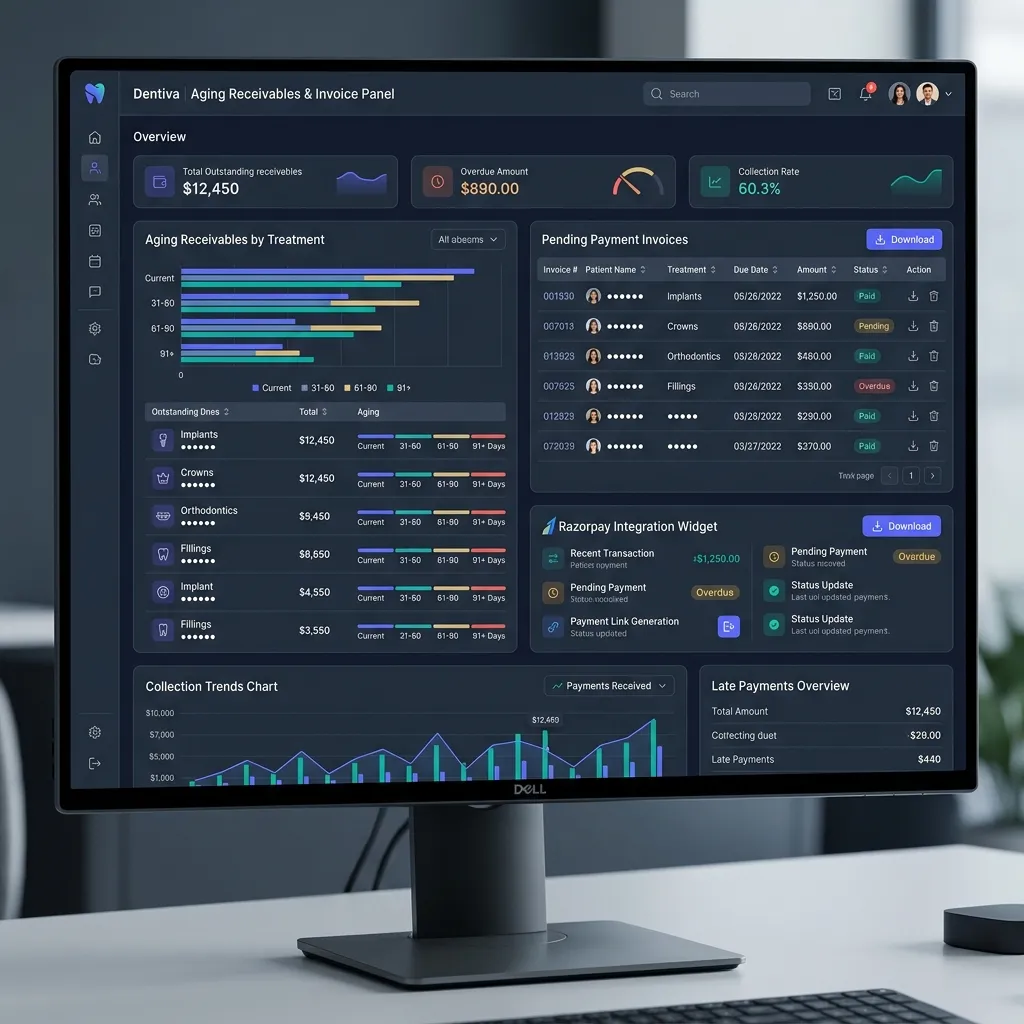 Screenshot: Dentiva Aging Receivables & Invoice Panel
As clinics scale, tracking these ledgers manually becomes impossible. Modern clinic management platforms simplify this operational burden.
Dentiva supports invoices, recorded payments and dues follow-up. A direct UPI link opens a payment app but does not itself confirm settlement. Verify a manual entry or supported gateway-confirmed payment before marking a balance collected. No recovery uplift is guaranteed.
Quick Action Checklist
Plugs billing leaks with this checklist:
Frequently Asked Questions (FAQ)
How do we handle patients who ignore automated reminders?
If a patient ignores three automated reminders, have your receptionist call them. Frame the call politely: "Hello [PatientName], we are updating our financial charts for the month. We noticed a pending balance of [Amount] on your file. Would you like us to resend the secure payment link via WhatsApp?" Focus on helpfulness rather than accusation.
Should we charge interest on overdue dental bills?
Charging interest is rare in Indian dental practices and can severely damage patient goodwill. It is far more effective to secure deposits upfront, hold lab-intensive work until advances are cleared, and send automated, polite reminders to maintain compliance.
What is a payment link, and is it secure for patients?
A payment link is a unique URL generated by a secure payment aggregator (like Razorpay). When tapped, it opens a secure page allowing the patient to pay via UPI, Netbanking, or Cards, protecting their financial data and automatically notifying your system of the payment.
How does EMR integration prevent billing errors?
EMR integration ensures that when the dentist records a procedure (e.g. a scaling or a filling) in the patient's clinical chart, the billing system automatically pulls the procedure code and generates the invoice, preventing staff from forgetting to bill.
How should we handle disputes about treatment costs?
If a patient disputes a bill, schedule a short call with the practice manager or the head dentist. Review the signed digital consent form and the treatment plan generated during onboarding. Transparency at the start of treatment is the best defense against billing disputes.
To evaluate this workflow, review Dentiva's dental billing features and check the actual screens, plan and permissions in a demo.
Discuss Billing & Collections Workflows
Uncover hidden revenue leaks, audit itemized treatment ledgers, and automate outstanding payment collections on WhatsApp.


